Writing a Naive LLVM-based Devirtualizer in Go
2026-06-15
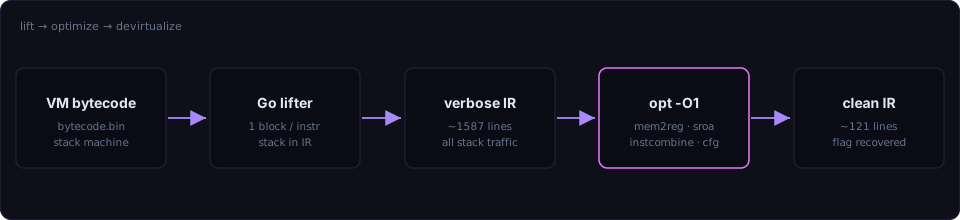
I have a habit of taking something written in one language and rewriting it in another, just to find out what the original was hiding. This time the victim is eversinc33's naive LLVM-based devirtualizer. The original is C++. I wanted the lifter in Go.
The interesting part of that article is not the C++. It is the trick: you do not
write a deobfuscator at all. You translate the virtual machine's bytecode into
LLVM IR, hand it to opt, and the compiler's own optimizer deletes the
virtualization for you. The smart code is already written. It ships with clang.
So the question I actually wanted to answer was: how little of my own code can I
write and still make opt collapse a virtualized flag checker back into plain
comparisons? Go turns out to be a good language to answer that in, precisely
because it has no real LLVM API. That constraint forces the design to stay
honest.
What virtualization-based protection is
A VM-based protector does not hide your function. It replaces it. Instead of
native cmp/je, your logic gets compiled to bytecode for a custom virtual
machine, and the binary ships an interpreter for that VM. When you disassemble,
you see the interpreter dispatch loop and a blob of bytes, not the logic. To
understand the program you first have to understand the VM, then hand-execute
its bytecode. That is the wall protectors like VMProtect, Themida or
BinaryShield put in front of you.
Our target is a small stack machine. Here is the entire instruction set:
const (
	OP_PUSH   byte = 0x01 // push imm (i64)
	OP_LOADIN byte = 0x02 // push input[idx]
	OP_ADD    byte = 0x03
	OP_SUB    byte = 0x04
	OP_XOR    byte = 0x05
	OP_MUL    byte = 0x06
	OP_CMP    byte = 0x07 // a, b -> (a == b) ? 1 : 0
	OP_AND    byte = 0x08
	OP_JZ     byte = 0x09 // pop; if zero, jump
	OP_JMP    byte = 0x0A
	OP_RET    byte = 0x0B // pop -> return value
)
The crackme it runs is a per-byte flag check, except every byte is XORed with a position-dependent key first, so the expected bytes never appear as constants in the bytecode:
// for each i: if (input[i] ^ key[i]) != (flag[i] ^ key[i]) return 0
for i := 0; i < len(flag); i++ {
	k := int64(keyByte(i))
	ct := int64(flag[i]) ^ k // obfuscated expected value
	p = append(p,
		loadin(byte(i)),
		push(k),
		instr(OP_XOR),
		push(ct),
		instr(OP_CMP),
		jump(OP_JZ, "fail"),
	)
}
A reverser staring at the assembled bytecode only sees loadin, xor against
some key, and a compare against some ciphertext byte. The flag is not there.
The plan: lift, do not interpret
The naive approach is one sentence. For every VM instruction, emit the LLVM IR
that performs the same operation, then run the optimizer. We never simplify
anything ourselves. Two design decisions make it work, and both are the kind of
thing you only believe once you have watched opt chew on it.
Decision 1: one basic block per instruction
We make zero effort to recover control flow structure. Every bytecode offset
gets its own LLVM basic block. Sequential instructions end with an explicit
branch to the next block. Jumps branch to the target offset's block. It looks
absurd, hundreds of blocks each holding a couple of instructions. simplifycfg
merges them all back together later. Recovering structure is the optimizer's
job, not mine.
Decision 2: the VM stack lives inside the IR
This is the load-bearing idea, and it is where my first attempt died, exactly as the original article warned.
My instinct as a Go programmer was to keep the VM stack as a Go slice of LLVM values at lift time: push an SSA value, pop it later, wire it directly into the next instruction. That is host-side bookkeeping. It breaks the moment control flow branches. A value pushed in one block and popped in another is not dominated by its use, and SSA falls apart. You end up needing to reconstruct phi nodes by hand at every merge point, which is the entire problem you were trying to make the compiler solve.
The fix is to stop being clever. Put the stack in memory:
// entry block, once
l.emit("%%stack = alloca [256 x i64]")
l.emit("%%sp = alloca i64")
l.emit("store i64 0, ptr %%sp")
push and pop become load/store against that alloca. Here is push:
func (l *lifter) pushVal(val string) {
	sp := l.reg()
	l.emit("%s = load i64, ptr %%sp", sp)
	slot := l.reg()
	l.emit("%s = getelementptr [256 x i64], ptr %%stack, i64 0, i64 %s", slot, sp)
	l.emit("store i64 %s, ptr %s", val, slot)
	nsp := l.reg()
	l.emit("%s = add i64 %s, 1", nsp, sp)
	l.emit("store i64 %s, ptr %%sp", nsp)
}
This generates spectacularly verbose IR. Every push is two loads, a GEP and two
stores. Every VM op touches memory several times. Good. That is the point. By
keeping the stack in memory instead of in my Go code, I am handing LLVM a problem
it is extremely good at: mem2reg and sroa promote those allocas to SSA
registers, inserting phi nodes wherever control flow merges. The stack I refused
to reason about gets reasoned about for free, correctly, by the part of the
compiler that does dominance analysis for a living.
The opcode lifters themselves are boring, which is how you want them. LOADIN:
case OP_LOADIN:
	p := l.reg()
	l.emit("%s = getelementptr i8, ptr %%input, i64 %d", p, d.idx)
	b := l.reg()
	l.emit("%s = load i8, ptr %s", b, p)
	z := l.reg()
	l.emit("%s = zext i8 %s to i64", z, b)
	l.pushVal(z)
CMP pops two, compares, pushes the boolean. JZ pops one and emits a
br i1. RET pops and returns. That is the whole lifter. No pattern matching,
no peephole rules, no knowledge of what the program does.
Watching the VM dissolve
Lift the basic crackme and you get about 1280 lines of IR that is almost entirely stack traffic. Then:
opt -O1 -S vm.ll -o vm.opt.ll
121 lines come out. The stack is gone. And the part that matters:
entry:
  %t2 = load i8, ptr %input, align 1
  %t33 = icmp eq i8 %t2, 103
  br i1 %t33, label %op_0019, label %op_01cc

op_0019:
  %t43 = getelementptr i8, ptr %input, i64 1
  %t44 = load i8, ptr %t43, align 1
  %t75 = icmp eq i8 %t44, 48
  br i1 %t75, label %op_0032, label %op_01cc
Look at what happened to the obfuscation. The bytecode computed
input[i] ^ key[i] and compared it to flag[i] ^ key[i]. instcombine knows
that a ^ k == b ^ k is just a == b, so it cancelled the key on both sides.
The comparisons are now directly against the plaintext flag bytes: 103 is g,
48 is 0, 95 is _. Read the constants down the chain and the flag falls out:
g0_d3virt_w1th_g0!. We never wrote a single line of code that knows about XOR.
This is the whole thesis. Represent the semantics faithfully in IR and the optimizer does the deobfuscation, because to the optimizer there is no obfuscation, only redundant code.
Hardening the handlers, and what survives
A real protector does not emit a naked XOR. So I added a hard mode with two
classic tricks to see what opt shrugs off.
Mixed Boolean-Arithmetic. Instead of xor, the handler computes
(a | b) - (a & b), which is an MBA identity for a ^ b. The lifter emits the
literal or/and/sub:
case OP_XOR_MBA:
	b := l.popVal()
	a := l.popVal()
	or := l.reg(); l.emit("%s = or i64 %s, %s", or, a, b)
	an := l.reg(); l.emit("%s = and i64 %s, %s", an, a, b)
	r := l.reg();  l.emit("%s = sub i64 %s, %s", r, or, an)
	l.pushVal(r)
instcombine folds (a | b) - (a & b) straight back to xor. Not every MBA
identity dies this easily, that is an arms race with its own literature, but the
common ones LLVM already knows.
Opaque predicates. Each comparison gets wrapped in a branch guarded by
((x | 1) & 1) == 1, which is always true, leading to a dead block full of junk
arithmetic. The lifter emits it honestly, true branch and junk branch both. LLVM
proves the predicate is constant true, deletes the junk block, and dce
removes the now-dead arithmetic.
The verbose hard IR starts at ~1590 lines. After -O1 it is the same 121 lines
as the basic version, and the recovered flag is identical. The hardening added
noise to the bytecode and changed nothing about the result. That is worth sitting
with: from the optimizer's point of view, MBA and opaque predicates are just more
dead code.
Because I drive the passes from Go, I can print the reduction one pass at a time and watch the VM come apart:
pipeline                           lines
(raw lift)                         1587
mem2reg                            1365
+sroa                              1365
+sccp,instcombine                  887
+gvn,simplifycfg,dce               287
full -O1                           121
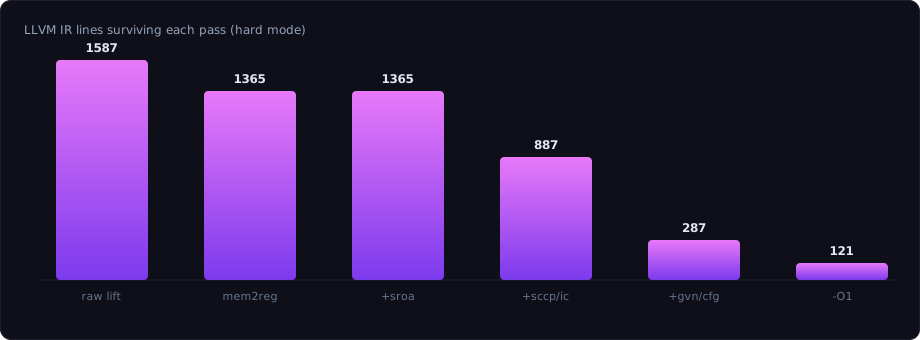
mem2reg promotes the stack pointer, sccp turns the now-scalar stack indices
into constants, sroa shatters the stack array into individual registers,
instcombine cancels the XOR and the MBA, and simplifycfg collapses the
block-per-instruction soup. Every pass is doing exactly one recognizable part of
the devirtualization.
Loops actually work, which is the real surprise
A flat flag check is the easy case. The honest test is a loop, because a loop is
where my naive "stack in memory" trick either pays off or detonates. So loop
mode adds locals (LDLOC/STLOC) and a backward jump, and computes a rolling
XOR checksum:
acc := 0
for i := 0; i < LEN; i++ { acc ^= input[i] }
return acc == CHECKSUM
The loop counter and accumulator live in VM locals, which I materialize in IR the
same way as the stack: an alloca [16 x i64]. Now there is a real loop carrying
state across a back edge. This is precisely the situation where host-side stack
bookkeeping needs hand-written phi nodes. With the state in memory, mem2reg
inserts those phi nodes itself when it promotes the locals. I do not write a
single phi.
After -O1 the VM is gone again. LLVM promoted the locals to SSA, saw the trip
count was fixed, and fully unrolled the loop into a chain of xors ending in one
compare against the checksum constant. The interpreter, the stack, the locals,
the back edge: all of it folded into straight-line arithmetic over the input.
Driving LLVM from Go
The one place Go fought me was talking to LLVM at all. The natural choice is the
cgo binding, tinygo.org/x/go-llvm. It downloads and compiles fine against the
LLVM 22 headers, then refuses to link: the binding is wired to -lLLVM-20 and
the link dies on undefined references to PassBuilder and DILocation. Making
it work means rebuilding the binding against the installed LLVM. That is a
yak-shave with no payoff for this project.
So I did the boring thing that actually works: emit IR as text and drive opt
and clang over os/exec. The lifter writes a .ll file, Go runs the pass
pipeline, greps the surviving icmp eq i8 comparisons to reconstruct the flag,
then compiles the optimized IR and runs it against the recovered flag to prove
the lift preserved semantics:
check("g0_d3virt_w1th_g0!") = 1  -> PASS
check("xxxxxxxxxxxxxxxxxx") = 0  -> FAIL
Emitting textual IR also turned out to be the more instructive choice. There is
no API hiding what gets generated. You see every getelementptr and every
redundant load, which is the whole reason the before/after is so stark.
What I actually learned
The lifter is a few hundred lines of Go that knows nothing about cryptography,
control flow recovery, or deobfuscation. All of that intelligence is borrowed
from opt. The two ideas that carry the entire technique are: represent VM
semantics faithfully in IR, and keep VM state in memory so the compiler's SSA
construction handles control flow for you. Get those right and MBA, opaque
predicates and loops stop being obstacles, because none of them survive contact
with an optimizer that treats them as ordinary redundant code.
This is "naive" devirtualization and it has real limits. It assumes you have already reversed the VM well enough to lift each handler correctly, which for a commercial protector is most of the work. It does not handle self-modifying bytecode or handlers whose semantics depend on runtime state you cannot model statically. But as a way to understand the shape of the problem, rewriting it in a language with no LLVM API was the right move. It left nowhere to hide the trick.
The code for this post is on GitHub: unveil.
Credit where it is due: the approach and the original C++ implementation are eversinc33's. I just wanted to see it in Go.